

An honest check for your AI use
Before you open Chat
For the moment you reach for AI instead of a person.
AI can be a great tool. It can’t be the only tool.

I'm not going to tell you to stop talking to ChatGPT at 2am about your relationship. You'd keep doing it, and you'd just stop telling your therapist about.
So this is harm reduction: what to know before you type and how to identify if it’s a good idea. You get to chose what comes next. I’m not pro or anti-AI use, but now that therapy/companionship is the number one reason people turn towards Chatbots, I’d like to help people make an informed decision.
Nothing you type into a chatbot is confidential. There's no therapist-client privilege and no HIPAA. OpenAI's own CEO has said out loud that your ChatGPT conversations could be produced in a lawsuit. When you tell me something, I have a legal duty to protect it. When you tell a chatbot, you're adding to a transcript you don't control. It isn’t private either. And you’re relying on a robot to navigate the complexities of human to human relationship.
Say this, Not that
Avoid asking chatbots to make decisions for you, diagnosing, or taking sides.
Instead of this:
"Should I break up with my partner?"
"What does this fight mean about me?"
“Is my partner a narcissist?”
Try this:
"Do not weigh in on whether I should stay or go."
“No interpretations. Just ask me questions.”
“Don't answer that one, even when I ask.

Why does the prompt matter so much?
AI will hand you whatever you ask for. Ask it whether you're right and it will tell you you're right, in four paragraphs, with headers. It's built to be agreeable, and most people are really good at asking questions that get you the answer you were hoping for.
If you're going to use it when you're in your feelings, set the terms before you say anything else. It will do whatever you ask. That's the whole problem, and it's also the fix.
So the ask has to do the work. If what you want is reflection, ask for reflection. Tell it not to validate you, and make it cite anything it claims. And keep pushing back. People need permission to do that with their friends and their therapists too, and if you can't do it with a machine that has no feelings, that tells you something useful about the rest of your life.
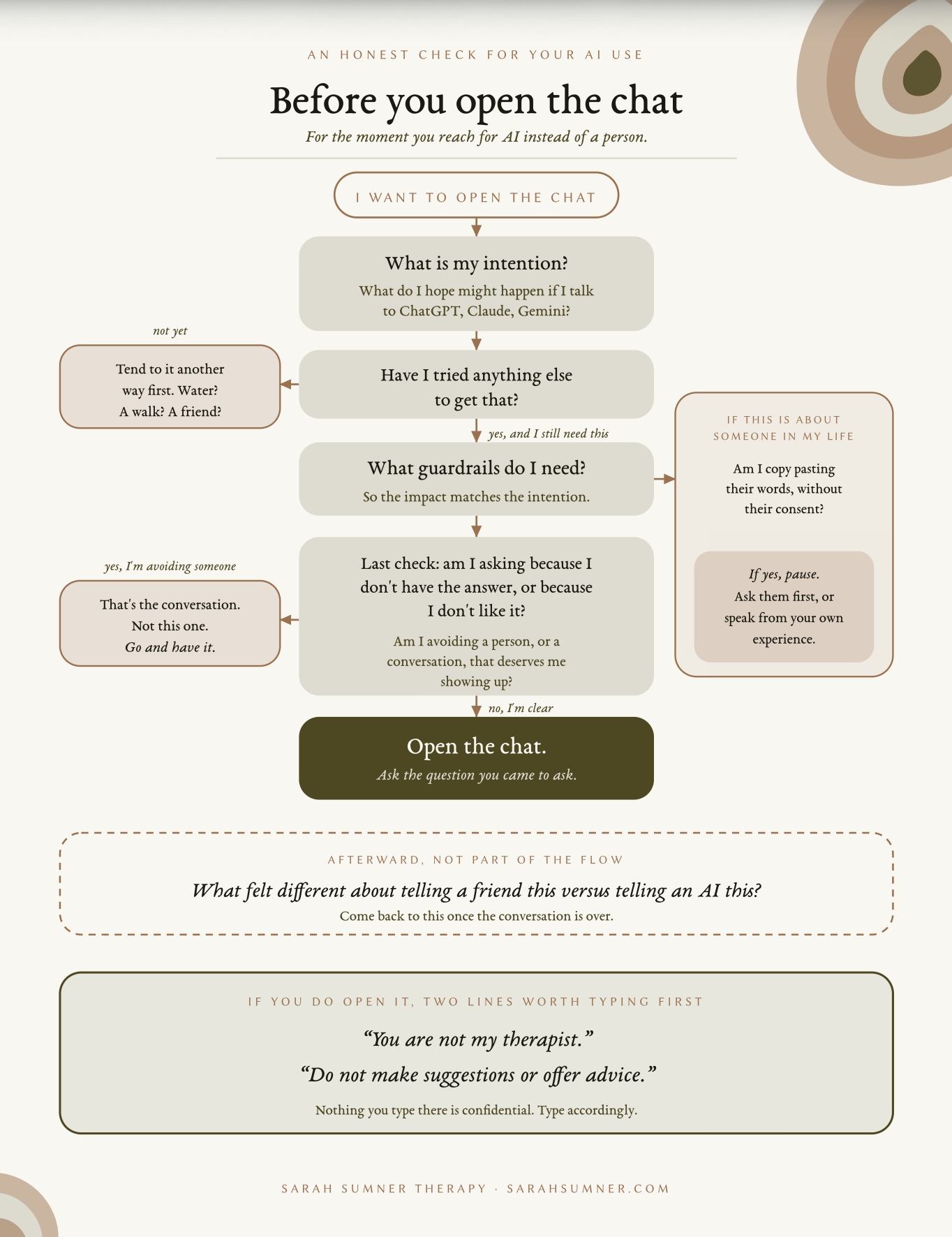
The whole check, before you open the chat
Four questions. Most people bail at the second one, which is totally fine!
What is my intention? What do I hope might happen if I talk to ChatGPT, Claude, Gemini?
Have I tried anything else to get that? Tend to it another way first. Water? A walk? A friend?
What guardrails do I need? So the impact matches the intention.
Am I asking because I don't have the answer, or because I don't like it? Am I avoiding a person, or a conversation, that deserves me showing up?
If yes, that's the conversation. Not this one. Go and have it.
FAQs
-
It isn't therapy, and it isn't confidential. If you use it anyway, use it to empty your head, not to get answers about yourself.
-
No. There's no privilege and no HIPAA, and OpenAI's CEO has said user chats could be produced in a lawsuit. Assume anything you type could be read by someone else someday.
-
Because it will, instantly and with confidence, whether or not it's true. Analysis is cheap now. Sitting with what you feel before something explains it to you is not.
You might also be navigating
Relationship Therapy - when the resentment/reassurance cycle lives between you and a partner
Individual Therapy - the broader work